
Speakers
Keynote Speakers

Prof. Julie K. Lundquist
Turbulence to turbine wakes: Opportunities in the atmospheric science of wind energy
Prof. Lundquist leads an interdisciplinary research group at Johns Hopkins University, with a joint appointment at the National Laboratory of the Rockies (formerly the National Renewable Energy Laboratory). Her research group uses observational and computational approaches to understand the atmospheric boundary layer, with emphasis on atmospheric influences on energy such as wind turbine productivity, wind turbine wake dynamics, and downwind impacts of wind energy. Before joining JHU, Dr. Lundquist designed and led energy projects at Lawrence Livermore National Laboratory and led a research group at the University of Colorado Boulder. Her Ph.D. is in Astrophysical, Planetary, and Atmospheric Science from the University of Colorado Boulder, as is her M.S. degree. She studied English and Physics as an undergraduate at Trinity University, San Antonio, Texas. She has authored or co-authored over 150 refereed publications and over 200 conference presentations. Her recent research focuses on offshore wind farm wakes and marine boundary layer dynamics (DOE WFIP3), interactions between offshore energy infrastructure and hurricanes (OWIND), and onshore wind farm wakes (through the DOE AWAKEN project). Beyond wind energy, her research projects include assessment of dissipation rate in the atmospheric boundary layer (NSF-CAREER), flow in complex terrain (NSF: Perdigão), and improving simulation capabilities for wildfire (DOI) and urban fires (OPP). She is a Fellow of the American Meteorological Society (2020) and received the NSF CAREER award (2016).

Jens N. Sørensen
Jens N. Sørensen is Professor of Fluid Mechanics at DTU Wind and Energy Systems. His research interests include Aerodynamics and Aeroacoustics of Wind Turbines, Computational Fluid Dynamics, and Vortex Flows. He is the main developer of the actuator line technique and has authored more than 200 peer-reviewed articles, mostly in the field of wind energy.

Philippe Spalart
Commonalities in Wind-Energy and Aerospace Research
Philippe Spalart studied Mathematics and Engineering in Paris, and obtained an Aerospace PhD at Stanford/NASA-Ames in 1982. Still at Ames, he conducted Direct Numerical Simulations of transitional and turbulent boundary layers. Moving to Boeing in 1990, he created the Spalart-Allmaras one-equation Reynolds-Averaged Navier-Stokes turbulence model. He wrote a review and co-holds a patent on airplane trailing vortices. In 1997 he proposed the Detached-Eddy Simulation approach, blending RANS and Large-Eddy Simulation to address separated flows at high Reynolds numbers with a manageable cost. He received the AIAA Fluid Dynamics Award in 2006, became a Boeing Senior Technical Fellow in 2007, was elected to the National Academy of Engineering in 2017, and had the AIAA Reed Award for 2019. His papers have been cited 54,000 times. Recent work includes refinements to the SA model and DES, computational aeroacoustics, theories for aerodynamics and turbulence, and the design of research experiments. Philippe retired from Boeing in 2020. He works part-time as Head of Flow Physics at Flexcompute.
Panel Wednesday, September 22, 2026: Opportunities on the roller coaster of wind energy United States.
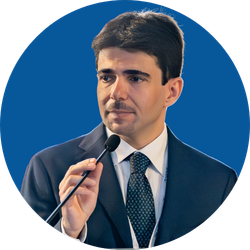
ALESSANDRO BIANCHINI
Alessandro Bianchini is Associate Professor at the Department of Industrial Engineering of the University of Florence (Italy). Prof. Bianchini currently also serves as the President of the European Academy of Wind energy (EAWE), Associated Editor of the Wind Energy Science Journal, and Member of the Management Committee of WindEurope.
In the field of wind energy, he has authored so far more than 200 publications in peer-reviewed journals and conferences, including the authorship of two papers among the recent “Grand Challenges Paper Series”.
His main research fields are wind turbine aerodynamics, floating offshore wind, and design/simulation of wind turbines and farms with multi-fidelity approaches, from engineering methods to high-computing Computational Fluid Dynamics.

ERIC SMITH
Eric Smith is an industrial and cleantech entrepreneur who led Keystone Tower Systems from founding through scale-up and acquisition. Keystone developed and commercialized tapered spiral welding, a new process for manufacturing towers for utility-scale wind turbines, and now operates roughly 1 GW of tower production capacity in Texas, with the technology expanding into new markets. Before Keystone, Eric ran a consulting practice that helped early-stage energy startups and their investors develop, evaluate and prototype new technologies. He holds more than 100 issued patents worldwide and graduate degrees in mechanical and electrical engineering from MIT.

ELIZABETH SALERNO
Liz brings more than 20 years of industry experience as a Principal at GQS New Energy Strategies where she advises clients on transforming wholesale energy market rules, facilitating new transmission and generation technologies, and navigating the FERC and RTO landscapes. Prior to GQS, Liz served as Lead Advisor for Chairman Rich Glick at FERC where she spearheaded reforms on the generator interconnection queue and regional transmission planning that were pivotal in shaping Order No. 2023 and Order No. 1920. She also advised on matters related to inverter-based resources and grid enhancing technologies while focusing on markets in MISO, SPP, and the west. Before joining FERC, Liz worked at Siemens and SiemensGamesa in various roles in the wind turbine and gas turbine divisions providing policy strategy across their equipment and service businesses. Liz began her career at the American Wind Energy Association as Vice President of Data and Analysis, where she led comprehensive economic and policy analysis efforts that shaped the industry’s position and built a team that serves as a leading source for market data.

NOAH MYRENT
Noah Myrent is a Principal Technical Leader at EPRI, where he leads wind power R&D focused on improving the reliability, performance, and cost-effectiveness of renewable energy assets. He specializes in wind fleet management, digitalization, data analytics, and condition monitoring strategies that support more informed asset decisions.
Before joining EPRI, Noah led ONYX Insight’s global monitoring program supporting thousands of wind turbines worldwide. Prior to ONYX, Noah was a research scientist for structural dynamics labs at Purdue and Vanderbilt.
He holds MS and BS degrees from Purdue University and has authored numerous publications on wind turbine blade health, monitoring, and renewable asset management.

PAUL VEERS
Paul Veers is the Executive Director of NAWEA and will be moderating the panel.